Tuesday, June 3, 2014

Sunset Boulevard (1950) dir. Billy Wilder

So this is the third entry in reverse alphabetical order on the registry, and the third film I've already seen before... Not sure if this is a benefit, because I can give a better analysis, or a hindrance because there is no discovery involved. I can't give a fresh and uninformed hackjob opinion on a movie I've never seen before by a director I'm not familiar with. When I was in the sixth grade, I spelled "familiar" as "framiliar" on a spelling test.
 
So, um, this movie was directed by Billy Wilder. He makes lots of good movies, or whatever. 

The Movie
I can't really give any insight to Billy Wilder as a director. I've only seen three of his films. Which isn't bad, I guess, but you know. Hitchcock is so iconic. Wilder is a household name, but he just makes good movies. You just have to take it at face value. 

He's primarily a writer and actor's director. He doesn't get a lot of praise for his visuals, but I've found that several of his more provocative works like this one have several great moments of clever visual language. There's a subtle but heavily structured visual concept to them (his film noir work is a good example, as the common staples of lighting and framing of the genre often involve very complex emotional and psychological metaphors).
A great example. Norma stands up in anger while watching one of her old films, just as the smoke from Joe's cigarette floats around her head. Like she is literally fuming. 
And a lot of the great German filmmakers share that tendency. But there's also a lot of narration in his noir stuff. This doesn't bother me in and of itself, but the fact that it's in his films specifically kinda makes me confuzzled. 

Billy Wilder actually has 10 screenwriting tips. One of them is to never include voice over that tells us what we already see. But the thing is, he fucking does that all the time. Yeah, it might slightly enhance what we're seeing, but it's redundant nonetheless. I'm fine with it. The narration is stylish and everything, just stop being such a lying shithole, Billy Wilder. 

And that kinda brings me to my main point. I really can't say with any degree of accuracy how important this film is in Billy Wilder's repertoire. But I bet it's his most important. That over-descriptive narration? While I believe it to be unintentional in his earlier noir, Double Indemnity (1944), I think it's satirical here. In Sunset Boulevard, Billy Wilder was calling his own bullshit. And Hollywood's bullshit. And my bullshit and your bullshit. 

Joe Gillis is a struggling screenwriter, who despite having the chops to pitch a screenplay, can't seem to actually write an original one. Running away from the repo men who are after his car, he hides in the house of the faded silent movie star, Norma Desmond, who has just laid her monkey to rest. 

Norma is batshit insane. She lives only with her butler, occasionally watching her old films and writing the outline for a film she wants to have made by Cecile B. Demille, when she's not doing poker games with Buster Keaton. 

She hires Joe to polish her screenplay, and soon starts grooming him as a romantic companion. He goes along with it, his desperation for money sucking every ounce of his integrity away. He starts to become a bigwig, impressing his friends in the industry. Meanwhile, he has a tentative romance with his friend Al's fiance, Betty. 

SPOILERS
Norma starts going crazier and crazier, and Joe simply can't take it, deciding he wants to both write and be with Betty. Norma's screenplay was ignored by Cecile B. DeMille, who pities her but will not give her a role anymore. I asked myself at one point, why doesn't someone give her a chance? And at that very moment, she reminds DeMille that she never works before 10am or after 4pm.

She loses it. Joe, even though he slept with her, turns her away and starts packing to leave for his old job in Ohio. He even turned Betty away, looking to rid himself of the whole business. Norma shoots Joe three times, killing him. The last scene depicts Norma coming down the steps of her mansion to be arrested while photographers flash their cameras at her. She believes she is doing a scene for Cecile B. DeMille's new film. 

Significance
Well, this is the opening shot: 

Right off the bat, we know we're stepping into the world of Hollywood, but we won't be seeing the glamour that Hollywood represents. Instead we're seeing what's below, the dirty street corners with big white words painted on them. We're gonna see some real shit. 

Like I said, this was Wilder's way of calling everyone's bullshit, specifically Hollywood's. And one of the ways he does this is by bullshitting us himself. 

He mocks audience and studio complacency by staging farcical sequences and taking away the resolution we expect from storylines and even individual sequences.
Joe is led to Norma's room, expecting to find something horrible. There has already been talk from her butler about moving a coffin. Turns out just to be a dead monkey. Disturbing, but kinda silly at the same time.
Butler plays the organ...
Norma goes through a series of utterly ridiculous beauty treatments to look her best for her new "movie".
The greatest source of tension is the collision of Old Hollywood and New Hollywood, much like old and new money in The Great Gatsby. Coincidentally, both films are about a man that went from dirt poor to rich through questionable means and ends up getting shot into a swimming pool over a love affair. 
Joe sneaks away from Norma's extravagant New Years celebration to catch up with his industry friends, who are all dressed normally in a cramped apartment, while he wears a full tux. 
And now, because of this film, we have the great subgenre or industry satire films. It's influence can be seen in films like The Player (1992), L.A. Confidential (1997), Swimming With Sharks (1994), The Artist (2012), etc... Films that play on industry standards, use the cut-throat atmosphere of the city to act as a dramatic backdrop, and include many nods to film and filmmaking. 
"You'd have turned down Gone With the Wind."
"No, that was me. I said, 'Who wants to see a civil war picture?"
It was 1950. Cinema had been around for almost half a century. It had evolved so much up to that point, seen good times and bad. And this film is like the halfway marker. It's a celebration of the industry, an indictment of it, and a bit of a "so what do we do now?" Sort of like a memo. It told us where we were at, and how to move forward. 

That's all I really feel like saying. I wanna watch something new. 

Tuesday, May 20, 2014

Vertigo (1958)

Vertigo (1958)
Boom. Look at me living up to my promises (so far). I actually watched the next film (in reverse alphabetical order) on the National Film Registry's selection from 1989. It's Alfred Hitchcock's classic, Vertigo. 

A Little on Hitchcock and This Film

Aside from Hitchcock being a master storyteller, a pioneer of film grammar, and an all around genius, I also like to remember him as the creepy and obsessive womanizer that he was. There was literally something mentally wrong with him, which is very unsettling when seeing how posh and composed he was in interviews and promotional material for his films.

And for me, personally, that's part of what makes his films so great and fascinating. I've been reading Sidney Lumet's autobiographical novel, Making Movies, and in it, he rants about how form follows function. Style is never separate from content. Yet he goes on to also say that in Hitchcock's case, he often handpicked stories to serve his particular style. I'm no pedigreed film scholar (yet), and I'm no Hitchcock expert, but I always get the sense of his personality when watching his films. I think they embody his persona as well as his inner darkness.


His films are made so masterfully with so much subtlety and detail, but also very structured and deliberately, much like like Hitchcock's very proper and calculated mannerisms (just watch any one of his Alfred Hitchcock Presents intros). Then, underneath, there is always some type of horror, menace, sexual deviancy, and dark humor confronting the audience. And while Vertigo, for me, is kind of just an okay film on its own, it's so much fun to think about afterwards. Because Alfred was kind of a sicko. And he knew it.


Most people have seen the film, so we all know it's about Jimmy Stewart, or John Ferguson-- a detective who leaves his retirement (having retired after a traumatic incident that gave him a fear of heights, and the fear gives him vertigo) to follow his friend's wife, who is apparently possessed by her great grandmother. 

The traumatic incident that caused all his fear and ineptitude was watching his partner fall from a high rooftop onto a green screen background to his death. 


And, of course, we know all this because Jimmy Stewart is kind enough to barrel out every piece of information in expository dialogue. 

One thing of interest-- John is shown later to be wearing a corset and using a cane. I guess he fell, too, and the shitty partner cushioned his fall. 

So he follows Madeline Elster, the wife of his friend, Gavin Elster, to see what her deal is. And he follows her really badly. Like, constantly behind her wherever she goes. Whenever I'm driving, someone only has to make two turns after me to make me think I'm being followed. People were more trusting back then. 

Anyway, it turns out she's pretty much got split personality disorder, sometimes assuming the identity of her deceased great grandmother who killed herself at 26. The fear is that Madeline will attempt to do the same thing. 

It's all SPOILERS from here on out, so be cautious. 

John falls in love with Madeline in the process of spying on her, and they form a relationship after John saves her from jumping into the San Francisco bay to her death. They kiss a lot by smashing their faces together. 


One day, they go to the country, near an old church (the setting of Madeline's nightmares about death), as a form of therapy. She runs up the church tower, and while John tries to pursue her, his fear of heights and resulting vertigo stop him. She jumps to her death. John is cleared of any blame, but not before the biggest douchebag judge in film history belittles him and makes him feel completely to blame. He even says that he "allowed" the death of his partner. But, clearly, the partner didn't get his proper footing before going to help Johnny-O. Rookie mistake.  

He is plagued by guilt and nightmares wherein he becomes a spooky batman villain. 

He meanders around most days afterwards, in a vacant and melancholic state. Then he meets a girl named Judy who looks like Madeline. Unbeknownst to him, Judy is Madeline, or rather, Madeline is Judy. It turns out Judy was hired by Gavin to pose as his wife and pretend to be unstable, so that he could kill his real wife and make John a witness to her "suicide". 

John and Judy begin a relationship again, and he starts making her dress exactly like Madeline and get her hair done the same way as well. He realizes that they are one in the same when he sees her putting on some jewelry that belonged to Madeline. 

So he takes her back to the church and confronts her, making her ascend the bell tower once more. At that moment, a meddling nun comes up and scares Judy/Madeline so bad that she actually falls off the tower and dies. John steps to the edge and looks down at her body in horror. 

So it's actually a happy ending, because he got over his fear. Gavin was just trying to help him after all. 
Good Guy Gavin- Kills his wife to help his friend get over his fear of heights.
Significance
There are several reasons that I would guess it's on here. The most obvious would be that it's one of Hitchcock's most popular and recognizable films. Although for me, personally, it isn't his best. I have some problems with it. 

First of all, it's a bit of a snooze for me. The master of suspense doesn't keep me in enough suspense. The following scenes just go on and on and on. 

But I think the greatest source of disappointment for me is the lack of Midge. 

That's Midge. She's introduced early on as John's friend, confidant, and former fiance. To me, she's the most interesting character in the film, and yet she's totally underused. I have to just admit here, I don't know why they wrote her in. 

She has this friendly, yet sort-of-but-not-really romantic relationship with him, and we know that they used to be engaged. She helps him find out some things about Madeline and her great grandmother, Carlotta Valdes, because she knows everyone in town. She even tries to help him cope after his second traumatic incident. 

She's this incredibly engaging, likeable, and mysterious character, but she just gets left to the side. We never really find out the significance of her and John's relationship and it is never resolved, either. The only benefit I can see from her presence in the film is to show that John is a failure at love, and that his obsession with Madeline/Judy results in the alienation of his only loved one (she is last seen leaving the mental facility he temporarily stays in, essentially giving up on him). 

And while that gives her some kind of explanation and function, it just isn't enough for me. I want more. I want a whole movie about her. 

Despite my qualms, with the film, though, I still have respect for it. And I understand why it's on the registry (while I'm sure I'll find others that I think shouldn't be on there). I don't want to talk forever about Hitchcock, because that would take so much time and effort. I'll just point out one or two of the major things it has going for it. 

It's, of course, just a well made and well put together film. Hitchcock has a wonderful sense of mise en scene (and I'm still not sure what that exactly means). 
I know it must mean this. The repeated square patterns on the walls, the constantly moving construction in the background, the overwhelming presence of red, and the constant trading of sitting and standing positions between Gavin and John all come together to create a tense scene where it feels like one is trying to trap the other, and that some kind of greater plan is at work. 
I also think the trickster, Alfred Hitchcock, is a guy with a sense of humor. He's tremendously cruel to his characters, such as placing John, a man with a fear of heights, near tall structures constantly. This type of thing is what one would call "hitchcockian". And the constant exploitation of a character's flaws is something that occurs in a lot of his films, especially in this one. 


No big deal, I only watched my partner die in a cramped alley. 
Like I said, Hitchcock's style tells us about himself. The film, for it's time, is pretty risque in portraying relationships and lust. John is nothing short of a mad, horny dog for madeline, and both of them are able to betray Gavin in some way in order to have each other. John and Hitchcock, while being strict and professional, also make some pretty bold moves and have some pretty dark instincts. 

Like this. John completely undresses Madeline while she sleeps. It's sort of violating. At this point in the film, he is still, more or less, a normal guy. Yet that elephant in the room, that he drove her to his house and undressed her instead of taking her to a hospital, starts peeling away at his facade of normalcy. 
Later, because she lied to him, he forces her up the bell tower again, and he's extremely threatening the whole time, like he wanted her to fall, almost. I get the feeling that it's both John and Hitchcock punishing her. 

It portrays this very bizarre power dynamic between the two. John has power over Judy because she loves him and wants to make him happy. So she dresses up like Madeline for him. Yet in a way, she has power over him, too, because she represents his desires. She can manipulate him by simply existing. 

And I think this very upfront, complicated sexual power dynamic was pretty new at the time. And both the structured and calculated personality given to John mixed with the chaotic, raving mad, sexual, and insidious underbelly that he hides is one of best examples of Hitchcock's form following his content, and perhaps revealing a bit about the filmmaker as well. 

Hitchcock was a weird dude. And this is one of the best showcases of that. 

Friday, May 9, 2014

The Wizard of Oz (1939)


Now that school is out, I've been trying to get a few projects together to keep myself busy. One of them will be actually keeping this blog updated, and I've found that giving it a more clear trajectory will make things easier and more fun. In addition to the occasional film review or special feature, I'm attempting to shoehorn in this experiment of sorts.

I've talked about the National Film Registry before. It's a pretty fascinating list. Basically, the only requirement to make the list is that the film must be at least 10 years old, and culturally, historically, or aesthetically significant.


Here's their homepage.


So in reviewing these films (and there are 650 of them), this blog might last forever, or until I decide to give up.


Let's begin this futile endeavor.


Let me start by saying that all the films on the list are American. So the "significance" is in regards to our country and culture. So I'll try to offer an explanation as to why it's on the list.


But let's just dive in...


The list began in 1989, so I'll start with that group. I'll do each year in reverse alphabetical order just cuz. The first film, then, is The Wizard of Oz.

Original poster, way cooler than the new ones.
The Movie
To spare you all a nostalgic and boring essay on how awesome the film is, I'll just try to sum it up in my own way. 

The Wizard of Oz is about a white trash family who sic their dog on old ladies and abandon their schizophrenic daughter during a tornado after some short lived, casual searching. The daughter then has a fever dream after being hit on the head by a window frame like a wimpy dumbass. 


This hopeless schizoid, Dorothy,  had run away from home after this huge c-word named Ms. Gulch steals her dog for the purposes of murdering it in cold blood after it bit her. 


Everyone says the Wicked Witch is the bad guy in this movie, but really it's Miss Gulch. Fuck her.


I can forgive the Wicked Witch. She's feared and reviled just for being green and ugly and then some random girl kills her sister and both the girl and the incredibly pompous Glinda refuse to give her the sister's only heirloom. Miss Gulch has absolutely no motivation to be a twat. She always pissed me off, even as a little kid. 


Anyway, Dorothy runs into a street mountebank named Professor Marvel, whose Phd is in cooking hotdogs over the fire. 


He essentially robs Dorothy and then tells her that her Aunt Em is dying of a heart attack, so that she will think she has no family to go back to and be forced to travel with him as his young lover.


He failed to take into account that she still has a drunk uncle and three farmhands to return to. She does so, much to Marvel's disappointment (he later visits her at her home, hoping to get some, but has to put on a facade when he sees her family is still alive, something he had not anticipated). 


So after she gets knocked out in the cyclone, she ends up in Oz, which is obviously a dream. I don't care what the books said, it's as clear as day in the film and everything that happens just reeks of dream logic. The dead witch's toes curling up into themselves is totally something you would dream.  


She's greeted by this insufferably self assured and unhelpful socialite who definitely has no magical powers except for turning into a bubble named Glinda. Glinda laughs derisively at Dorothy's confusion and unleashes a horde of dwarves to ogle her. Let's point out my favorites, shall we? 


This guy struts slowly across the frame, desperately clinging to the small amount of fame that he has. 


This one makes this face like she really knows what she's talking about, and she always caught my eye as a child.
When I was a kid, I thought this guy said "You killed us so completely". So as a child, I thought dorothy killed all the munchkins when her house landed, turning them all into ghosts. And they were thankful. 
This particular munchkin is Harry Earles, who plays the main character in Tod Browning's Freaks (1932). 
Glinda gets threatened by the Wicked Witch, and then Glinda tells her she has to see the Wizard and floats off in her bubble, refusing to offer any more help. Which is crap. Glinda doesn't have anything better to do, she's just a horrible person. 

So Dorothy goes to see the Wizard, essentially the god of Oz, so she can go home. She runs into a Scarecrow with muscular atrophy, a tin man who wears mascara, and a lion who inexplicably has a New York accent. They all set off in hopes that the wizard will cure their maladies with homeopathy. 


After several speed bumps and delays, mostly from accidentally running into munchkin actors hanging themselves in the background, they arrive at Emerald City, a bizarre dystopian community where nobody has a job (we get up at twelve and start to work at one, take an hour for lunch and then at two we're done. Jolly good fun!). Those who do have jobs are presumably in indentured servitude, and even at that they are severely understaffed, as they have one guy doing three jobs that require different uniforms. 


So they see the wizard, a floating hologram head, and he says they have to kill the Wicked Witch and bring back her broomstick. They head out to her castle, Dorothy gets kidnapped, and her friends have to save her. 


Some really lame shit happens, and the witch lights Scarecrow on fire because he totally held his arm out for her to do it and then freaked out when she called his bluff. 

Also, Tin Man's face. Gold. 
Luckily, the witch is a huge diptshit who, despite her deathly allergy to water, leaves buckets of water just lying around. So Dorothy gets some on her when she uses the water to put out scarecrow. Witch dies.

Then, and this is where I get totally lost, they bring back the broomstick and the wizard still refuses to help them. Then, Dorothy's dog, Toto, starts meddling around where he shouldn't (which is what got her in trouble in the first god damn place), and reveals the wizard to be just some old turd in a booth. 

Now what I don't get is, if he was just a normal guy with no motives or agenda, why was he being such a dick in the first place? And when he's revealed, everyone is pretty much cool with it after a few seconds. He's like "Yeah, I was just jerking you all around, let me get your shit". And that's the end of it. 

So anyway, he tries taking dorothy home in a hot air balloon but Tin Man totally sabotages it. 


So Glinda drags her useless ass up there and tells Dorothy to tap her heels together three times, making some bullshit excuse that Dorothy had to learn a lesson before she went home. 


She wakes up at home and she tells her family about her dream, but they just laugh it off. I don't blame them. Ever had someone describe their dream to you? It's like, oh my god, who cares? 


Credits. 


Why Is It On the List?

In all seriousness, I love this movie. I love almost all of the songs, and the dancing from the Scarecrow and Tin Man are some of my favorite parts of the movie in particular. What's crazy, though, is that in some bizarre way, it's aged incredibly well. That's what makes it culturally significant.  

Older movies are often less watched by the younger crowd because films were simply different back then. You need to develop a taste for them at this point. Yet parents go out of their way to show this movie to their kids, and almost every kid is enthralled by it as if it were made today. 


And you wouldn't necessarily think that given the subject matter. Just think about it. A girl goes to a fantasy land and hangs around with a talking scarecrow, a lion, a tin man, runs into wizards and witches-- what a clusterfuck! There were several attempts to make the film before and they all sucked because no one knew how to handle the content. 


The decision to shoot in color for the Oz scenes, of course, made a huge difference. This is part of what makes it both historically and aesthetically significant. Color was a relatively new thing, and just look how they use it. They make a distinction between fantasy and reality. Color is used thematically, not just to look pretty.  


But in my opinion, I think they kind of made fun of themselves a little, and that makes everything easier to accept. Look at some of this. 


Bert Lahr really hams up in this role. And I don't think it has everything to do with the demands of the part. I think he's giving us a wink wink. 


That sense that we get that the filmmakers are saying "Yeah, we know this is pretty silly", and adding little nudges to us about that is part of what makes the film successful. It's self awareness has allowed it to endure. 


It's a really big film that took that crazy premise by the horns and wasn't afraid to be tongue-in-cheek. That, and some of those songs are just undeniably wonderful. 


It's no surprise it's on the list. And I honestly think that most of us would be really confused if it weren't. 

Sunday, April 20, 2014

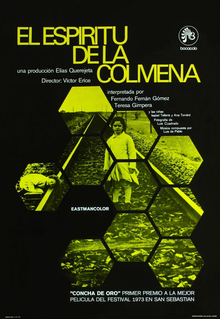
Spirit of the Beehive (1973) dir. Víctor Erice

Maintaining this blog has been a little more worrisome than I thought it would be, and that's because I worry too much. 

I remember making the first post thinking I was just gonna review movies. But then I wanted to have more of a gimmick, and that's when I said I would review the AFI top 100 list. I later thought I should review the National Film Registry. And I'd still like to do that. 


But for now...


There are 625 films on the registry. I've always been fascinated it. According to its Wiki page, it includes everything from abandoned and neglected films to TV movies, newsreels (Hindenburg Disaster Footage), home movies (The Zapruder film), and music videos (Michael Jackson's Thriller). 


One of the most interesting things in the home video category is Disneyland Dream, which is just 16mm footage of a family's trip to Disneyland that they won in a contest. But get this, a young Steve Martin shows up 20 minutes into the film for a few brief moments, walking in the lower part of the frame. He worked there at the time. 


Anyway, all this really has nothing to do with the subject of this blog post. I only bring it up to say that I have not followed through with my promise to gimmick up my blog, as the movie I watched yesterday is on no lists, and is not recent. 


It's called The Spirit of the Beehive, and it might be one you've never heard of, so that's why I'm talking about it. 


More On the Director
This is the first of only three feature films by Spanish filmmaker, Víctor Erice. He's done several short subjects both before and after his three features, but hasn't really made much after 1992. Although, he was on the jury of the 2010 Cannes Film Festival. 

He lived through the oppressive regime of Francisco Franco, and much of his work is influenced by this, like many other Spanish Filmmakers. 


Because the regime was a completely totalitarian dictatorship that didn't end until Franco's death in 1975, filmmakers had to completely disguise their anti-fascist messages with very subtle symbolism. Luis Bunuel, the guy who made Un Chien Andalou (1929) (An Andalusian Dog) with Salvadore Dali, was another filmmaker, like Erice, who had to struggle with the government to make films, and some of those also have political messages that made it through the censors. 

Many critics agree that the crumbling family life in the Spirit of the Beehive, the references to worker bees, the differences between the two female siblings, all represent different criticisms of the dictatorship. 


Víctor Erice
While this is true, the film is also just a very beautiful, simple tale of childhood. And while showing a childhood tale, it shows the drama that occurs when people feel alienated, and what happens when people who are each going through separate life journeys alienate themselves and others instead of uniting. To make it even better, it shows these conflicts through parallels to the commonly known story of Frankenstein.

The Film 


Ana is a naive, doe-eyed, and highly adventurous and inquisitive young girl. She lives in a fairly nice if not rustic farmhouse in rural Spain during 1940, with the Francoist regime in full, infantile force. She lives with her mother and father, and sister, Isabel. It's kind of hard to describe the plot because it is so understated and simple.

I don't know a lot about Spanish cinema from that time (or let's face it, any time), but from what I can gather, directors were, aside from making hidden political statements, looking for a more pure and simplistic form of cinema and storytelling. It would be best not to mistake this for bland, because the films, especially this one, are incredibly rich-- visually and performance-wise. 


But in regards to the story being told, there is an event and subsequent events that tie everything together, and while it moves at a very slow and meditative pace, it's exciting and fascinating nonetheless.


A travelling movie (basically a beat up truck taking a projector and film reels from village to village) shows up in Ana's village in the Castilian plateau. The movie is a Spanish dub of Frankenstein from 1931.

A beautiful shot in the film. I love seeing smoke through light rays.
 The townspeople, almost exclusively children (or at least, a heavier emphasis is put on them as audience members), watch the movie in fright and amazement. The scene from the film where the monster throws the girl into the water, not knowing it will kill her, is removed, and instead the scene where he carries her corpse into the village is shown with very little context.  

This causes Ana to question what happened to the girl, and why Frankenstein's monster was killed by the townspeople. She forms an obsession with this tragic creature, and is sometimes afraid of it as well. Her sister shows her an abandoned barn and says the monster lives there. One day she finds a rebel from the civil war hiding in the barn, and it is possible that she believes he is the monster.


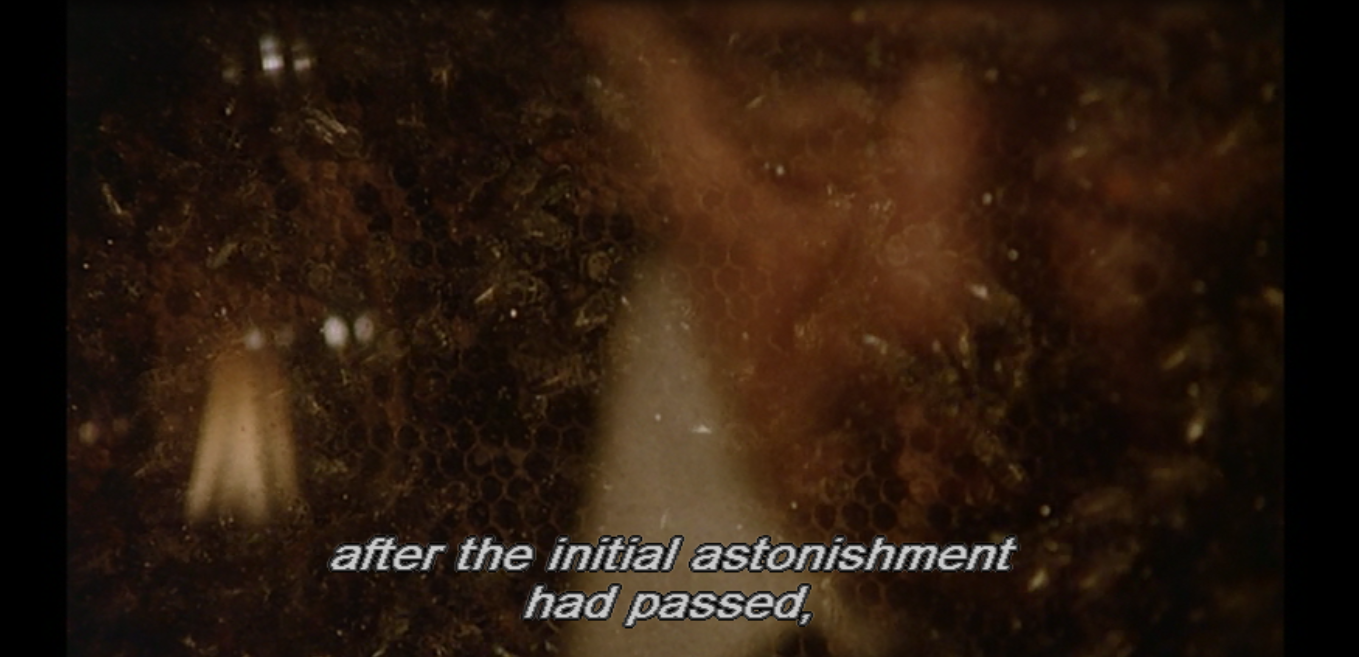
Meanwhile, her sister, a few years her senior, starts to yearn for womanhood. Her mother sits vacant and longing in the house, sending letters to an unseen lover. The father tends to his bees, and writes about them extensively in his study with hexagonally patterned, yellow tinted windows that confine him in a human honeycomb. 


Each member of the family is struggling with something different. There's a very quiet emotional torment going on in all of the characters, even young Ana who struggles to understand why everyone walls themselves up in their doubts and troubles, her only problem being her longing to know more about the monster, to understand what he is. She also wants to know if he's a spirit, and what a spirit is. 

The mother is unhappy in her marriage, and the father can only think about his bees, and how their mindlessness and repetitive nature vexes him (as said before, this is an allusion to the worker bee life of Spain's oppressed citizens). One of the most often cited and striking aspects of the movie is the fact that the husband and wife are never in the same shot for the entire film. 


Like I said before, it's a slow film, but it's still fascinating. A lot of people don't like slow films with plots like this, that take their time to unfold and don't ascend to anything particularly climactic. Sometimes I feel that way. But I think there are two things that really great films like this make a point of doing. 


One is, for me anyway, avoiding a lot of dialogue. I'd much rather see characters doing things, even if I have to question the actions, than hear them talk. What's great about this film is that they both accomplish that and make it extremely appropriate, because the movie is about children. Children don't really experience things through conversation. They are visual and tactile learners, for the most part. I think we can all relate to that, because as children, weird and inspiring things can simply happen in front of us that we remember for a long time. We do things that we go back and think about as adults, and wonder why we did it. 


There's a shot in the film that's really good at showing this: 

On one of the days Ana explores the abandoned barn, she sees this large footprint. There's no explanation as to why it's there (it is possibly from the fugitive soldier). This large footprint, to her, can come from no one but the large, hulking monster. She stares at it, and puts her foot into it. Her facial expression in the scene is nervous, and yet she doesn't run away, she examines it further. She is both afraid of and fascinated by the monster. And what's more is, she identifies with him, with his loneliness. She is constantly compared to the monster. Actually, there are many comparisons throughout the film to Frankenstein.


The schoolchildren assemble a man for an anatomy lesson
The father describes showing some bees to a colleague in his journal, the wording mirrors Victor Frankenstein's exact sentiments after seeing his creation alive.
It's cool as all hell.

I think I'm especially delighted about it because I just read Frankenstein not a few months ago. 


While Ana is compared to the creation, her father is compared to the mad doctor. And the fact that he did, in fact, create her, makes it even more compelling. Does he abhor the family he created because he has failed to make it perfect, much like Victor Frankenstein abhors his creation for being imperfect?


In a political or historical context, this comparison might make the father a symbol of Franco, a cold mad scientist, controlling a hive of worker bees. 


The sister, Isabel, is seen by critics to represent the narcissism and greed of the regime, as she teases Ana and acts as if she thinks she is much smarter and better than her. Subtly, of course. The sisters are also shown as very fond of each other. 


Maybe the mom represents misplaced priorities. 


And that's the second thing I think a movie like this needs and does well-- compelling characters. Not just complex characters, but unique and compelling ones. Character's that sometimes do things we don't understand. 


Oh, and the movie is eye cocaine. 


All the barren empty landscapes, again, are believed by critics to be another politcal allegory. I think they compliment the distance in the family, more importantly. 


I probably have a lot more to say about this film, but what I've covered should just about do it. 


Definitely watch this.  


If you like Guillermo Del Toro (Pan's Labyrinth [2006], The Devil's Backbone [2001]), then you'll like, if not love, this. The focus on children, adventure, and just the general tone that seems mythical and mysterious is something this film and the films of Del Toro share. There's no way he didn't draw influence from this film. 


Movies I Also Saw Recently

City of God (2002)*, I Have Found It (2000)**, Symbiopsychotaxiplasm (1968)***, Ghost (1990)****

*re-watch. Saw it when I was around 12 and couldn't comprehend the greatness of it. Watching it now was so good and so hard to watch. Like getting the best massage of your life but being slapped in the face with cold rubber. 


**this was the silliest, cringiest, and most entertaining movie I've seen in a while. A bollywood musical at its finest. 


***This was the weirdest, most thought provoking and entertaining movie I've seen in a while. I would explain what it was about, but that would be too hard. For the love of god, click this 


**** As corny as it is, this movie gives me the feels every damn time. 


Seriously, man... why you gotta be so sad, movie? 
ALSO
I've talked a lot about obscure movies here. So in the spirit of discovery, let me embed two great short films, one of which many have seen, another which very few have seen. 

The first is An Andalusian Dog, because I mentioned it earlier and it's great.


The second is called The Girl Chewing Gum and it's an experimental short from 1976. It's mesmerizing. It's not a collage film, like the previous films I've talked about on this blog, but still an experiment. I kind of want to give you a premise, or at least some context. But I saw it without context, and that was a major part of my enjoyment factor. So just watch it, you'll eventually catch on. And hopefully love it.